

Radiation Oncology
Radiation Oncology
Course Description
Cancer is a leading cause of adult mortality across the world. It is a fascinating and exciting field of science to work in. The Department of Oncology is part of the Medical Sciences Division at Oxford, the emphasis being on the word 'sciences’, this is not a route into medicine, it is a route into becoming a research scientist, or into the biomedical sciences in general. Our researchers come from across the UK and the World. They come from biology, chemistry, physics and maths. During the Radiation Oncology course, you take part in a combination of laboratory, theory and tutorial sessions and will meet men and women who do amazing work to improve tomorrow's cancer medicine.
Our three-day course will introduce you to the exciting science behind cancer research and treatment, exploring three interconnected areas: radiobiology, medical physics and clinical oncology. You'll discover how scientists from different disciplines work together to understand cancer, develop new technologies and improve treatments for patients.
We will begin by exploring what cancer is, how cancer cells behave and why they can be so difficult to treat. Through radiobiology, we will investigate how radiation interacts with living cells, how it damages DNA and why some cancer cells respond differently to treatment. We will explore how researchers use this knowledge to develop more effective radiotherapy treatments while protecting healthy tissue.
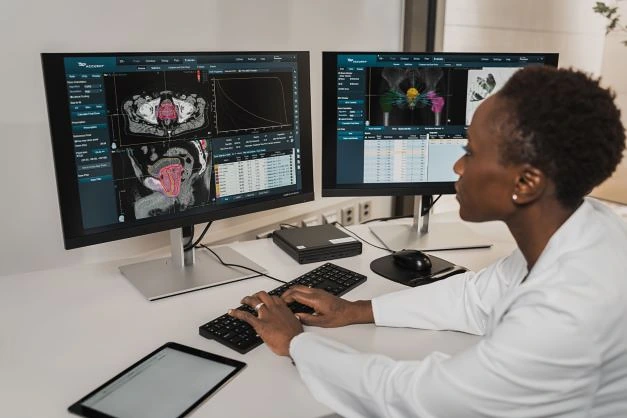
We will also discover the important role that physics and mathematics play in modern cancer medicine. Through medical physics, we will explore how radiation is used to treat tumours, how advanced imaging technologies allow us to see inside the body, and how scientists use physics, technology and mathematical approaches to plan and deliver precise treatments. You'll learn how developments in medical physics are helping to make cancer treatment safer, more accurate and more personalised.
Finally, we will explore clinical oncology and discover how scientific research translates into treatments for patients. How do clinicians decide which treatment is most appropriate? How can imaging, radiotherapy and our understanding of cancer biology be combined to improve outcomes? And how do discoveries made in the laboratory become advances in clinical practice?
Throughout the course, you will take part in a combination of practical activities, interactive sessions and discussions with researchers working at the forefront of cancer science. Whether your interests lie in biology, physics, mathematics or the wider biomedical sciences, this course will give you an insight into the many different scientific approaches involved in tackling cancer and the exciting opportunities for a future career in cancer research.